

Conference
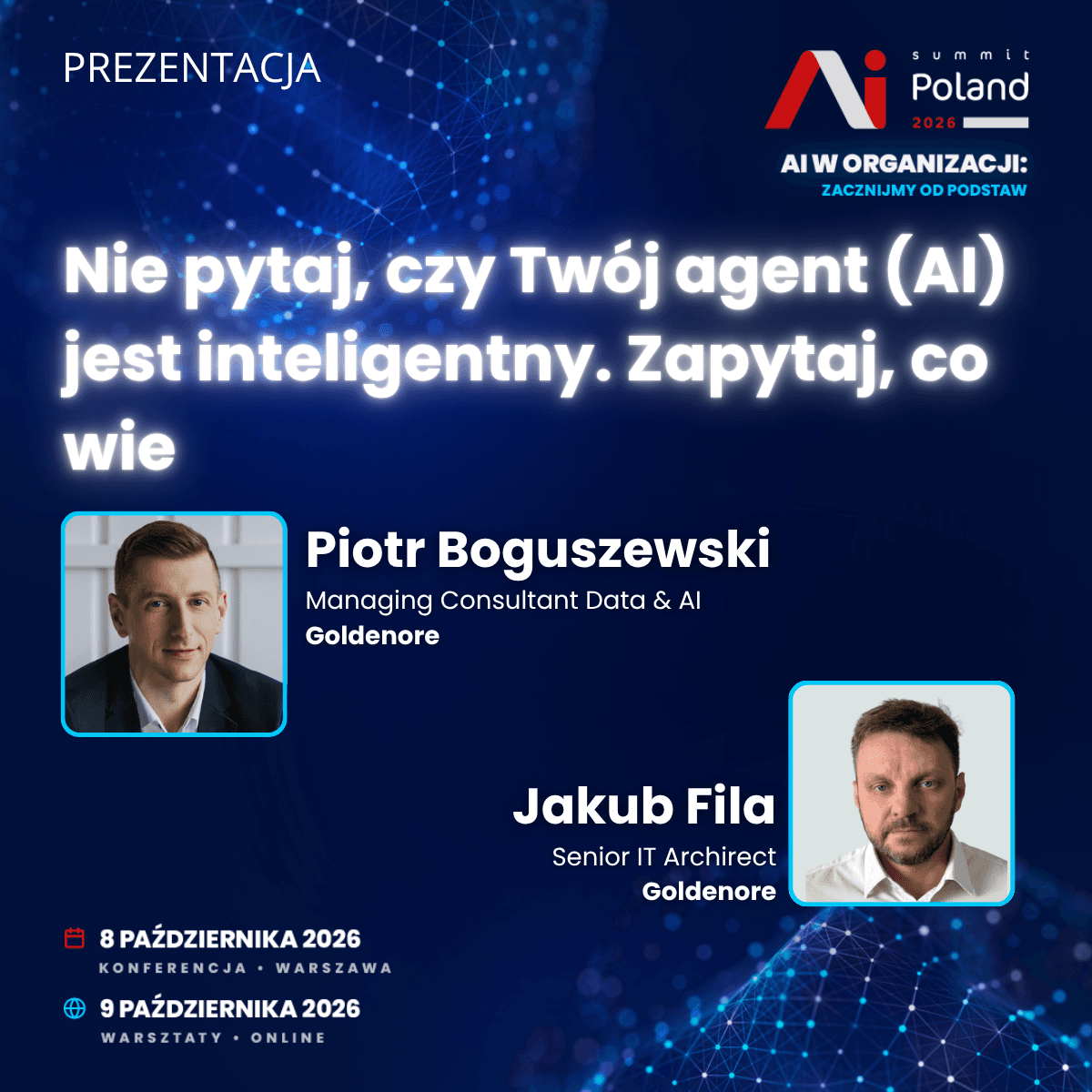
Don't ask whether your AI agent is intelligent. Ask what it knows
At AI Summit Poland 2026, we presented what determines the quality of AI responses in practice: data, its organization, freshness, semantics, and accessibility. Your AI knows exactly as much as your data can tell it — and it does not know what it does not know.
What was the presentation about?
What does your AI really know?
A large language model does not query your organization's systems on its own. To answer a question about the company, it must receive the right context or gain access to data through tools. This means that the quality of an AI response begins before the model itself — it begins with data. We showed what happens between a user's question and the model's response, and why having complete data does not yet mean that AI can use it effectively.
What can replace or complement RAG?
We also presented other approaches to providing models with knowledge:
Knowledge graphs and GraphRAG
Semantic layers and text-to-SQL
Agents using APIs and MCP
Data products and feature stores
Context from events
Skills and knowledge repositories for agents
The goal is not to choose one technology. It is to match the architecture to the type of data and the question AI is expected to answer.
Six questions to ask before implementing AI
Is there one definition and a designated source for each key business concept?
Do you know how current the data behind the model's answer is?
Do source-system permissions carry through to indexes and model responses?
Can you identify the source and version of the data used to produce the answer?
Can the model recognize that it does not have enough information?
And finally: does the organization know what its AI does not know?
Data is the foundation of AI
AI architecture is secondary to data organization. RAG, knowledge graphs, and agents can use data only to the extent that it is accessible, described, current, and properly secured. Preparing data for AI is therefore not the final stage of an implementation. It is the foundation of the entire solution. During the presentation, we examined the problem from a data-architecture perspective — from source systems and semantics, through RAG and agents, to the architecture of the AI ecosystem.

Speaker
Piotr Boguszewski
Piotr Boguszewski has worked with data and analytics for nearly 20 years, from data warehouses to CRM systems. He focuses on connecting business and technology perspectives and translating complex data challenges into practical solutions. In recent years, he has concentrated primarily on artificial intelligence, particularly Generative AI, and on putting its potential to practical use in organizations. His experience spans both consulting and team management, from small specialist teams to larger regional structures.

Speaker
Jakub Fila
An experienced systems and solutions architect specializing in application design, efficient programming, data warehousing, big data, numerical computing, and machine learning algorithms. He studied Applied Mechanics and Physics / Applied Mathematics and completed an MBA in management accounting and finance at Warsaw University of Technology. His career includes IBM, Teradata, Accenture, Deloitte Digital, and BCG Platinion, combining deep technical expertise with strong business understanding.
Want to getthe presentation or access?
Phone
Email address
Office
Al. Jerozolimskie 160, 02-326 Warsaw
Company details
Goldenore Sp. z o.o.
KRS: 0000924344 | NIP: 6342815553 | REGON: 243185818
Watch the recording
Watch the full presentation, “What Does Your AI Know? Data Organization as a Prerequisite for Effective LLM Systems,” from AI Summit Poland 2026 and see what must happen in the data layer before AI can truly use your organization's knowledge. Let's talk about the data behind AI in your company.
AI Summit Poland 2026
Photo gallery
Explore photos from the conference, our presentation, and the roundtable discussions.